
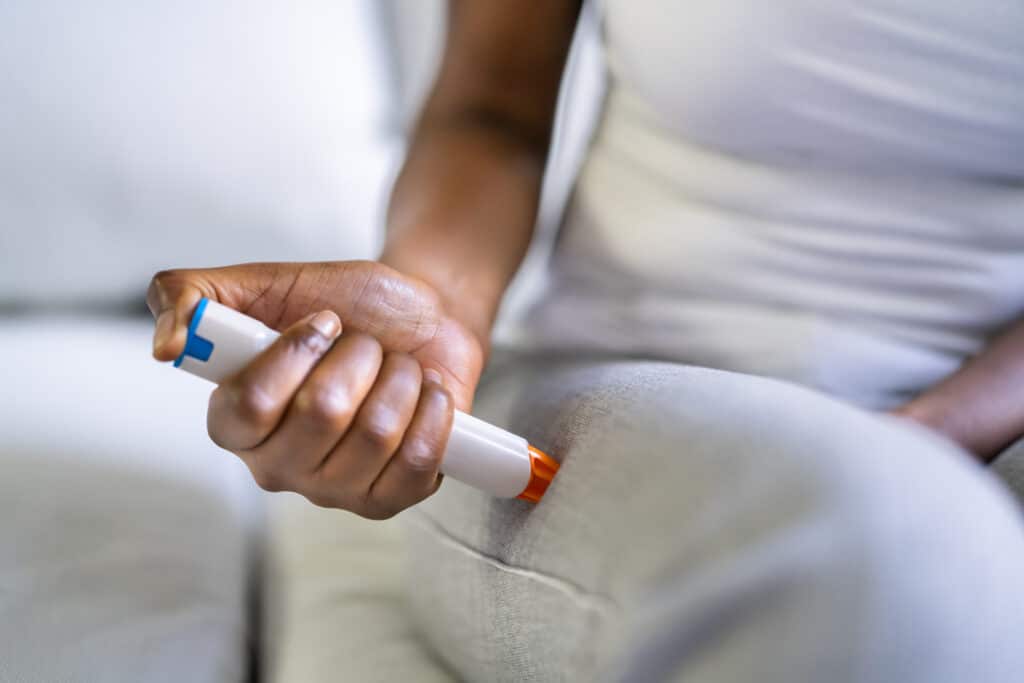
Picking Up Where We Left Off
In Part 1, we talked about the uncomfortable truth pharmacy professionals see every day: epinephrine works, but fear gets in the way. Needle anxiety, hesitation, and device intimidation create a gap between having epinephrine and actually using it when it matters most.
That gap isn’t theoretical. It shows up in refill patterns, expired devices, rushed counseling sessions, and patients quietly hoping they never have to use the medication they were just prescribed.
If fear is one of the biggest barriers to timely epinephrine use, then the next logical question isn’t whether patients should use epinephrine sooner, it’s whether we can make epinephrine easier to use in the first place. That’s where this conversation turns from psychology to design.
In Part 2, we’re looking at why needle phobia isn’t just a patient issue but a market-level problem, and how intranasal epinephrine challenges long-standing assumptions about what anaphylaxis treatment has to look like.
Needle Phobia Isn’t a Minor Issue — It’s a Market Problem
In healthcare, we have a bad habit of labeling anything emotional as “secondary.” Fear gets lumped in with inconvenience. Anxiety gets brushed off as something education will fix. Needle phobia gets treated like a personal quirk instead of what it actually is: a predictable barrier that affects behavior. When enough people behave the same way, it stops being an individual issue and starts being a market problem.
Fear changes what people do, especially in emergencies. In anaphylaxis, the goal is simple: use epinephrine early. But fear changes decision-making. It slows people down. It makes them second-guess symptoms. It pushes them toward “safer-feeling” options like antihistamines or waiting it out. This isn’t because patients are irresponsible. It’s because in a crisis, the brain looks for the least frightening path first. If the treatment feels extreme, people delay it until the situation feels extreme enough to justify it. That delay is where outcomes suffer.
We see the effects in the data and at the counter. You don’t need to dig deep into the literature to know something isn’t working. Pharmacy sees it every day:
- Low refill rates after the first fill
- Devices expiring untouched
- Patients declining refills because “we still have one at home”
- Confusion about when to use it
- Hesitation baked into every counseling session
When a therapy is lifesaving but underused, that’s not a compliance problem — it’s a design problem.
The thought that education will fix it is a myth. Pharmacy professionals are great educators. We explain. We demonstrate. We repeat ourselves. But education has limits. You can:
- Explain how epinephrine works
- Show how to use the device
- Emphasize urgency
- Share worst-case scenarios
And still lose the moment when fear takes over. Because education works best when people are calm. Anaphylaxis is not a calm situation.
Needle fear hits certain groups harder. This is where equity comes into play. Needle fear disproportionately affects:
- Children
- Adolescents
- Caregivers
- People with anxiety disorders
- People with past medical trauma
- Individuals with developmental or cognitive disabilities
- Older adults with dexterity or vision challenges
When a delivery system doesn’t account for these realities, it quietly excludes people — even if the drug itself is effective.
Fear also affects access, not just use. Fear doesn’t just delay administration. It affects whether patients even want the medication in the first place. Some patients:
- Never pick up the prescription
- Avoid refills
- Decline additional devices for school or travel
- Downplay their risk to avoid confronting the issue
From a market standpoint, that means:
- Lower adoption
- Lower persistence
- Lower real-world effectiveness
It doesn’t matter how good a product looks in clinical trials if it is never used in real life.
This matters to the epinephrine market because, for decades, it has focused on:
- Dosing
- Device mechanics
- Cost
- Branding
But behavior hasn’t changed much. We still rely on:
- Patient bravery in emergencies
- Caregiver confidence under stress
- Bystanders acting without hesitation
That’s a fragile system. When a market ignores human behavior, it plateaus. Innovation slows. Outcomes stagnate.
Needle-free isn’t about convenience, it’s about behavior. This is where intranasal epinephrine enters the conversation in a meaningful way. Removing the needle:
- Lowers the psychological barrier
- Makes action feel less extreme
- Increases the likelihood someone will actually do something
- Expands who feels capable of helping
This isn’t about making things easier for the sake of comfort. It’s about aligning the treatment with how people actually behave in emergencies.
Pharmacy is the reality check. Pharmacists and technicians are uniquely positioned to see this disconnect. We don’t just see prescriptions, we see hesitation. We hear uncertainty. We watch fear play out in subtle ways. And when we see the same patterns over and over, it’s a signal.
The signal here is clear: the delivery method matters more than we’ve been willing to admit. If fear is limiting use, limiting carry, and limiting confidence, then fear is shaping the market, whether we acknowledge it or not. Which brings us to the next logical step in this conversation: if removing the needle could reduce fear, improve confidence, and change behavior … how does intranasal delivery actually work, and is it fast enough to matter?
That’s where we go next.
So … Why the Nose? (And Why It Actually Makes Sense)
At first glance, intranasal epinephrine can sound a little strange. Epinephrine is serious, high-stakes medication. We’re used to it coming with needles, warnings, and a very intense vibe. So when people hear “nasal spray,” the immediate reaction is often skepticism. Is that really strong enough? Is it fast enough? Is this just trying to make medicine more “comfortable”? Fair questions. But once you understand the science, the idea of nasal epinephrine stops sounding soft and starts sounding practical.
The nose is a shortcut, not a detour. The inside of the nose is highly vascular. That means drugs delivered there can be absorbed quickly into systemic circulation. This isn’t new or experimental thinking. We already rely on intranasal medications when we need:
- Rapid onset
- Easy administration
- Reliable absorption without IV or injection access
Think about the medications pharmacy already trusts intranasally:
- Naloxone for opioid overdose
- Midazolam for seizures
- Sumatriptan for migraines
None of those are “gentle” drugs. They’re used when time matters. Epinephrine fits that same profile.
One of the biggest concerns pharmacists have is onset of action. Rightfully so. Intramuscular injection sets a high bar for speed. Intranasal epinephrine doesn’t need to beat it, it just needs to be fast enough to matter clinically. The nasal route offers:
- Rapid absorption through the nasal mucosa
- Quick rise in systemic drug levels
- Avoidance of first-pass metabolism
In other words, it gets the drug where it needs to go without making patients jump through hoops. “But what if the patient is congested?” This is usually the first question, and a fair one. Allergic patients often are congested. So it’s reasonable to worry that nasal symptoms could interfere with absorption. The reassuring part:
- Nasal formulations are designed with this in mind
- Clinical studies account for variability in nasal conditions
- Real-world intranasal drugs work across a wide range of patients
Is nasal delivery perfect in every scenario? No, but neither is injection, especially if it never gets used.
Reliability versus real-world use, this is where the conversation gets more nuanced. Injectable epinephrine is extremely reliable when administered correctly. Intranasal epinephrine is designed to be reliably used. Those are not the same thing. A therapy that’s slightly less “ideal” in a lab but far more likely to be used quickly and correctly can outperform a perfect therapy that sits unused in a bag. Pharmacy professionals understand this tradeoff better than most.
Simplicity is a feature, not a flaw. Intranasal delivery removes several steps:
- No needle
- No injection angle
- No force requirement
- No hold time anxiety
- No fear of accidental sticks
The fewer steps involved, the fewer things can go wrong, especially for non-medical users under stress. From a counseling standpoint, this matters. A lot.
What about kids, caregivers, and bystanders? Nasal sprays are familiar. People use them all the time. That familiarity lowers the intimidation factor. It:
- Makes caregivers more confident
- Makes teachers and coaches more willing to act
- Makes bystanders less afraid of “doing harm”
In an emergency, confidence drives action.
This isn’t about replacing science, it’s about using it better. Intranasal epinephrine isn’t trying to reinvent anaphylaxis treatment. It’s applying what we already know about pharmacology, anatomy, and human behavior in a smarter way.
Same drug. Different route. Lower barrier. And when you lower the barrier to action, you don’t just change patient experience, you change outcomes.
When Behavior Changes, Outcomes Follow
If there’s one takeaway from this conversation, it’s this: delivery matters.
Not because injectable epinephrine is ineffective, it isn’t. But because in real life, under stress, fear shapes behavior more than clinical perfection ever will. A treatment that people hesitate to use is a treatment that can’t fully do its job.
Needle phobia isn’t a niche concern or a personal failing. It’s a predictable human response, and when it affects enough people, it becomes a market problem. It influences whether epinephrine is carried, refilled, administered early, or used at all.
Intranasal epinephrine doesn’t change the drug, it changes the moment. By removing the needle, it lowers the psychological barrier to action. It simplifies decision-making. It expands who feels capable of stepping in during an emergency. And in doing so, it has the potential to improve outcomes.
For pharmacists and pharmacy technicians, this isn’t just an interesting innovation, it’s a shift that aligns with what we already know from experience. Patients do better when treatments feel manageable. Caregivers act faster when they feel confident. Bystanders intervene more readily when they’re less afraid of causing harm.
Intranasal epinephrine isn’t about replacing injectables overnight. It’s about expanding options in a way that reflects real-world behavior, not idealized scenarios. And if we want better outcomes in anaphylaxis, we may need to stop asking people to overcome fear, and start designing treatments that work with human behavior, not against it.